 Country of origin:
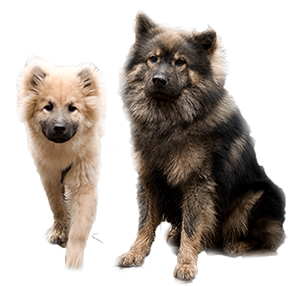
Germany Date of publication of the valid original standard:06.01.1994 Use:Companion dog. FCI classification:Group 5 No. 291 (Spitz and primitive types), Section 5 (Asian Spitz and related breeds), without working trial. Brief historical summary:In 1960 a Chow-Chow and a Wolfspitz were crossed and the breed known as “Wolf-Chow” was created. Later a Samoyed was added and, since 1973, the breed has carried the name Eurasier - a connection between the breeds of Europe and Asia - and has been recognised by the FCI. General appearance:Harmoniously built, medium-sized, Spitz-type dog with erect ears, in various colour combinations, with a coat length that still allows the body proportions to be recognised, and with a medium-heavy bone structure. Important proportions:The body is slightly longer than high. The ratio of muzzle length to cranial length is approximately equal. Behaviour and temperament:Self-confident, calm and even-tempered, with a high threshold of stimulation; watchful and attentive without unnecessary noisiness, with a strong and pronounced bond to its family. Reserved with strangers, but without aggression. It lacks a hunting drive. For the full development of these traits, the Eurasier needs constant and close home contact with its family, as well as understanding yet consistent upbringing. Head:Harmonious, skull not too broad; wedge-shaped when seen from above and from the side. The bridge of the nose and the top of the skull are parallel. Cranial region:Skull: Flat forehead with a clearly visible frontal furrow. Well-developed occipital protuberance. Stop: Slightly marked. Facial region:Nose: Medium-sized, nose leather black pigmented. Muzzle: Neither too coarse nor too pointed, tapering towards the nose. Bridge of nose and lower jaw straight. Lips: Edges of the lips tight and black pigmented. Jaws / teeth: Strong jaws, broad curve of the lower jaw. Strong, complete dentition (42 teeth according to the dental formula); either a scissor bite or pincer bite. Upper incisors either fit closely over the lower incisors or meet them directly. Premolars and molars are in one row without gaps. All teeth must stand vertically in the jaw. Cheeks: Only slightly pronounced. Eyes: Dark, medium-sized, neither set too deep nor protruding. Eye openings set slightly oblique. Eyelids black pigmented and fitting tightly. Ears: Set apart by about the width of one ear base, medium-sized and triangular, erect. Tips slightly rounded. The tips of the ears and the centre of the stop form an almost equilateral triangle. Neck:Medium length, in harmony with the general appearance, well muscled. Skin on the throat fitting tightly. Flowing transition from neck to body. Body:Strong trunk, not too short. Withers: Pronounced. Back: Firm and straight, very well muscled. Loin: Of good length and width, very well muscled. Croup: Straight, broad and strong. Chest: Reaches to the elbows. Ribcage oval in shape. Well developed forechest, but not too pronounced. Tail: Long, set on straight, round and firm, of good thickness and tapering towards the tip. Bushy coated, carried forward over the back or bent slightly to the side, or curled. Hanging down, it reaches the hock. Limbs:FOREQUARTERS: General appearance: Viewed from the front, straight and parallel; seen from the side, moderately angulated. Upper arm and forearm are of almost equal length. Shoulder: Well muscled, shoulder blade set slightly oblique. Upper arm: Medium long and strongly muscled. Elbow: Close to the chest. Forearm: Medium long, well muscled. Carpal joint: Strong. Metacarpus: Medium long, viewed from the front absolutely straight, from the side sloping slightly forward. Forefeet: Oval, tight, with moderately arched toes; strong, dark pigmented nails. Pads firm, well cushioned, black pigmented. Dense coat between the pads. HINDQUARTERS:General appearance: Viewed from behind, straight and parallel; seen from the side, moderately angulated. Thigh and lower thigh are of almost equal length. Pelvis: Set slightly oblique. Upper thigh: Medium long and strongly muscled. Stifle: Stable, not too open. Lower thigh: Medium long, well muscled. Hock joint: Not too low set, stable, neither turning in nor out. Metatarsus: Good length and width, perpendicular when viewed from the side. Hind feet: Oval, tight, slightly arched. Nails dark pigmented. Pads firm, well cushioned, black pigmented. Dense coat between the toes. Gait:Ground-covering movement with plenty of reach and good drive. Skin:Tight and pigmented. Coat:Hair: Dense undercoat all over the body and medium-length, loosely fitting outer coat. Muzzle, face, ears and front of the legs are covered with short coat. Tail, backs of the forelegs (feathers) and hind legs (breeches) are covered with longer coat. The coat on the neck is only slightly longer than on the body and does not form a mane. Colour: All colours and colour combinations are permitted except pure white, white patched and liver colour. Size and weightMales: 52 - 60 cm, 23 - 32 kg Females: 48 - 56 cm, 18 - 26 kg Balance of proportions is decisive; however, the desired ideal values are the medium heights and weights. Males: 56 cm and 26 kg Females: 52 cm and 22 kg Faults:Any departure from the foregoing points should be considered a fault and the seriousness with which the fault should be regarded should be in exact proportion to its degree. Disqualifying faults:Insufficient sexual characteristics. Missing one incisor or canine, or missing several of them; missing one or more premolars 3 or 4, or missing one or more molars 1 or 2. Bite anomalies. Ectropion, entropion, eyes set too deep or too small. Distichiasis (eyelashes growing in a double row). Drop ears, hanging ears. Kinked tail. Strong loss of pigmentation. Fearfulness, shyness, exaggerated suspiciousness. Aggressiveness. Note:Male dogs must have two apparently normal testicles fully descended into the scrotum. Exceptional characteristic breed feature:The EURASIER breed must have at least one blue spot anywhere on the tongue, or the tongue may be entirely blue or blue-spotted. |
Our dogs
RiJa Bohemia
About the breed
Character, history and information about the Eurasier breed.
The breed in everyday life